
Your Company Is Not “AI-Native” Until Dave From Accounting Gets It
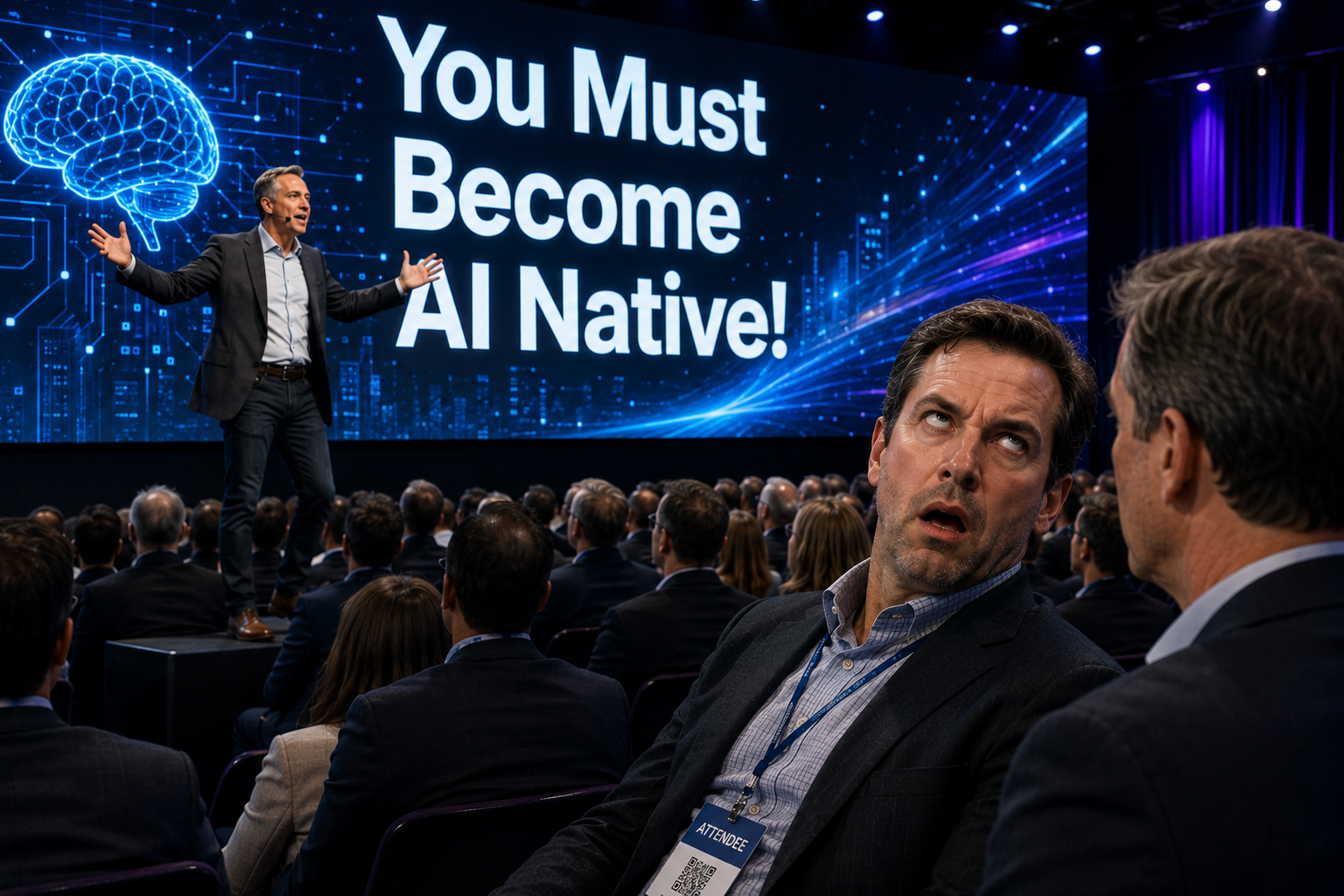
Every tech CEO has had the same terrifying realization sometime after a funding round or their third cold brew of the day:
“Wait… what if a 22-year-old running Claude agents can replace our entire company?”
The terror of this insight is then amplified by the LinkedIn post of another founder who claims that AI increased their productivity “10x” while reducing headcount, office space, and apparently the need for sleep.
Naturally, the only rational response is to gather your management team and declare:
“We must become an AI-native organization.”
Of course, nobody knows what this means, but everyone nods seriously because the alternative is appearing “not visionary,” which in tech culture is punishable by podcast irrelevance.
So now begins the new sacred ritual known as: AI Transformation.
First comes the all-hands meeting
You stand before the company with the energy of a wartime prime minister and announce that AI is no longer optional. The future belongs to organizations that “move fast, automate workflows, and leverage intelligent systems at scale.”
The engineering team smirks because they already use AI every day. The sales team immediately asks if AI can attend discovery calls for them. Later, Marketing tries to boost inbound traffic by issuing droves of AI-generated blog posts with titles like: The Future of Synergistic Innovation.
Meanwhile, Dave from accounting quietly uploads the payroll spreadsheet into a free chatbot because of: “all the reports I can generate with AI!”
This is progress?
In response, you hire an “AI consultant”
This is a person who had AI generate a PowerPoint deck that describes everything that AI could possibly do for your business- which is, of course, everything your business now does.
They conduct workshops where managers learn essential enterprise AI concepts like prompt engineering, workflow orchestration, agentic systems, etc., ending with the admonition that: “we should circle back on governance.”
Nobody really understands any of these phrases but, because this is part of our strategy now, all nod along.
Then at some point, your Head of Product insists we need an “AI layer.” This seems fitting because your product already had:
a cloud layer
a platform layer
a social layer
a blockchain experiment everyone avoids discussing
and now, finally, an AI layer.
Meanwhile, you’re still waiting for the icing to be applied to this layer cake.
You know- revenue growth.
But the pressure is real
Investors are asking about AI on every call: “What's your AI strategy?”
Translated into plain English, this means: “Please reassure us you won’t be destroyed by two graduate students operating from a Miami apartment.”
So, the company responds accordingly.
Customer support gets AI summaries
Engineering gets (more) coding agents
Sales gets AI-generated follow-up emails so aggressively enthusiastic they sound like hostage notes
Even HR adopts AI, which somehow makes rejection emails both faster and colder- “We appreciate your interest” messages sent instantly to 435 applicants by a robot trained exclusively on disappointment.
Still, despite the chaos, something remarkable starts happening
People become faster
The mediocre first draft disappears
Research that once took days now takes minutes
Meetings become shorter because AI generates summaries nobody reads instead of humans generating summaries nobody reads
And slowly, your management team realizes AI is not actually replacing employees. It’s replacing:
Blank-page paralysis
Repetitive tasks
Formatting PowerPoints at midnight
and Greg’s “special process” that only Greg understands
This is when the panic shifts. The threat is no longer: “AI will take our jobs.” Instead, you see the real threat is that: “Another company using AI will move five times faster than we do.”
That’s the real do-or-die moment for a company. Because tech firms do not lose when giant corporations outspend them. They lose when:
they lose focus on their reason for being
fail to prioritize tactics according to key business objectives
when competitors learn faster than they do
AI is fundamentally a speed multiplier
A decent employee with AI can outperform an exhausted team operating manually out of tradition and Slack notifications.
The companies that win will not necessarily have the best models. They’ll have cultures where experimentation is normal, adoption is expected, and nobody needs executive approval to automate something painfully stupid.
Including the weekly leadership status meeting.
Especially the weekly leadership status meeting.
So yes, CEOs should push AI adoption aggressively.
Not because every AI demo is magical
Not because every workflow needs an AI agent
And certainly not because your investors saw a keynote presentation in San Francisco
But because the companies that learn to integrate AI operationally, even if they do so imperfectly, awkwardly, or even chaotically, are building organizational reflexes their competitors will struggle to catch.
Which is why we advocate a four-step process to systematize AI integration
1. Identify Opportunities
2. Assess Readiness
3. Prioritize What Matters
4. Execute & Prove ROI via Pilot Projects
Also, because Dave from accounting has already automated half his job anyway.
You might as well get ahead of it.
By Ken Marshall, Managing Partner