
The Hidden Cost of Building without a Technical North Star – The Case of Earn Phone

The Earn Phone was built on a powerful idea: Turn everyday phone usage into income.
Users earned points for listening to music, charging their phones, playing games, and reading news. An Earn Phone monetized the experience through embedded ads and shared revenue with users by allowing points to be redeemed for cash.
Growth was rapid. Engagement was high.
But the product couldn’t keep up.
The Decline: No Star in Sight
The mobile app became unstable, inconsistent, and confusing. Music sessions failed. Games crashed. Ads interrupted flows unpredictably. Point balances appeared incorrect. Cash-outs failed or lagged.
Users didn’t just complain—they lost trust.
“This app feels shady.”
“They’re trying to cheat us.”
Behind the scenes, the organization mirrored the product.
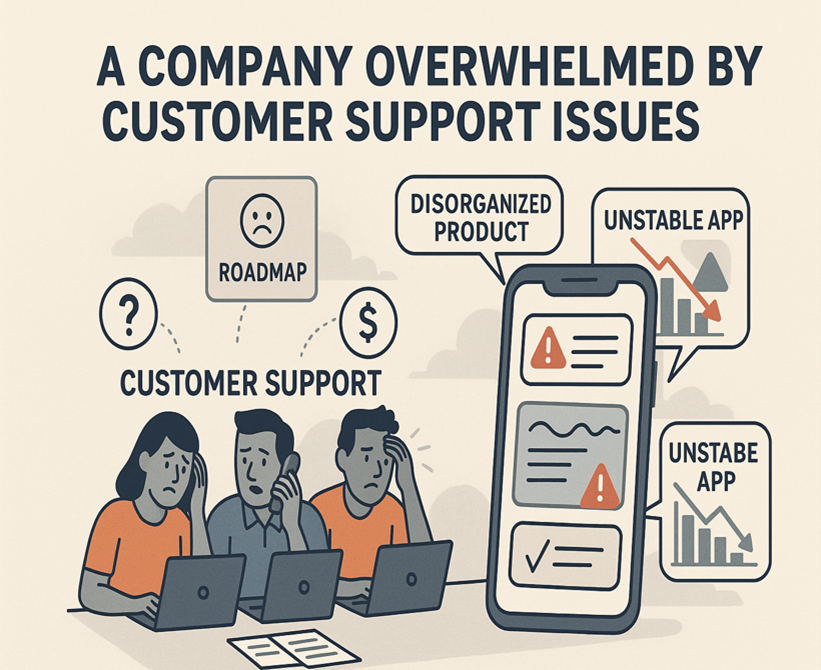
There was no product roadmap
Teams were organized in silos (music, ads, charging, games, rewards)
Each team shipped independently
No one owned the end-to-end user journey
Support was the only feedback loop
The company didn’t lack effort. It lacked alignment.
The Struggle: Firefighting as a Way of Life
Every day started with urgency:
Zendesk tickets flooding in
Engineers pulled into emergency fixes
Product managers reacting instead of planning
Leadership asking, “Why does this keep happening?”
The only data available was customer complaints. No funnel analytics. No feature health metrics. No trust indicators.
Earn Phone wanted to use AI, but like many startups, they faced the common paradox:
“We know AI could help—but we don’t even know what questions to ask.”
Without structure, AI would only automate confusion.
The Turning Point: Using AI to Create Shared Truth
The recovery started with a simple decision:
Start with the data we already have.
Every Zendesk ticket was ingested and analyzed using AI-driven techniques:
Topic clustering to group recurring issues
Sentiment analysis to quantify trust breakdowns
Root-cause extraction across features
Trend detection to identify emerging problems
Impact scoring based on frequency and severity
The results were immediate and eye-opening:
82% of support volume traced to 6 core failures
Point accuracy issues were the single biggest trust killer
Ad timing conflicts disrupted earning sessions
Siloed releases were breaking downstream features
“Urgent” internal work often had little customer impact
For the first time, the company had one version of reality.
The Fix: Alignment First, AI Second
AI exposed the problems—but people had to fix them.
1. A Unified Earn Phone Roadmap
Built from customer-impact data, not opinion:
Trust and payout reliability first
App stability second
Monetization optimization last
2. Reorganizing Around the User Journey
Teams shifted from features to outcomes:
Acquisition & onboarding
Engagement & earnings
Ads & monetization
Rewards & payouts
Trust & integrity
3. AI as an Operating System, not a Feature
With alignment in place, AI became a force multiplier:
Automated ticket classification and routing
Early-warning signals for crashes and trust degradation
Predictive alerts for payout anomalies
AI summaries feeding roadmap decisions
Continuous feedback loops replacing guesswork
The Results: From Chaos to Control
Within three months:
Support volume dropped by 35%
Point accuracy complaints dropped by 70%
App stability reached enterprise-grade levels
Revenue per user increased
Teams reclaimed focus and confidence
Most importantly, users began trusting the Earn Phone again.
The Insight: Falling into the Speed Trap
Early-stage startups move fast—and they should. But speed without technical leadership often creates invisible debt that compounds quietly until it overwhelms the organization.
This is especially true for mobile-first, ad-supported platforms like the Earn Phone, where stability, trust, monetization, and user experience are tightly coupled. Without a clear product strategy, shared architecture principles, and data-driven prioritization, teams fall into predictable traps:
Siloed feature teams optimizing locally instead of holistically
No unified product roadmap or system ownership
Engineering teams stuck firefighting instead of building
Support teams acting as the de facto product signal
Founders relying on intuition instead of insight
The Lesson: Seek the North Star
AI didn’t save the Earn Phone on its own. Leadership, alignment, and disciplined execution did. AI simply made the truth undeniable, then fueled the generation of ongoing truth.
When leadership establishes a technical north star early on alignment happens, and execution- both AI and human- can follow under its guiding light:
Establish a unified product roadmap
Design cross-team ownership models
Build analytics and trust metrics from day one
Introduce AI as a decision engine, not a gimmick
Prevent silo-driven instability
Such guardrails can help young technical startups avoid fundamental problems before they metastasize - establishing product clarity, technical governance, and data foundations by which to navigate.
By Chip Correra, Partner