
Taking the Fight Out of Prioritization
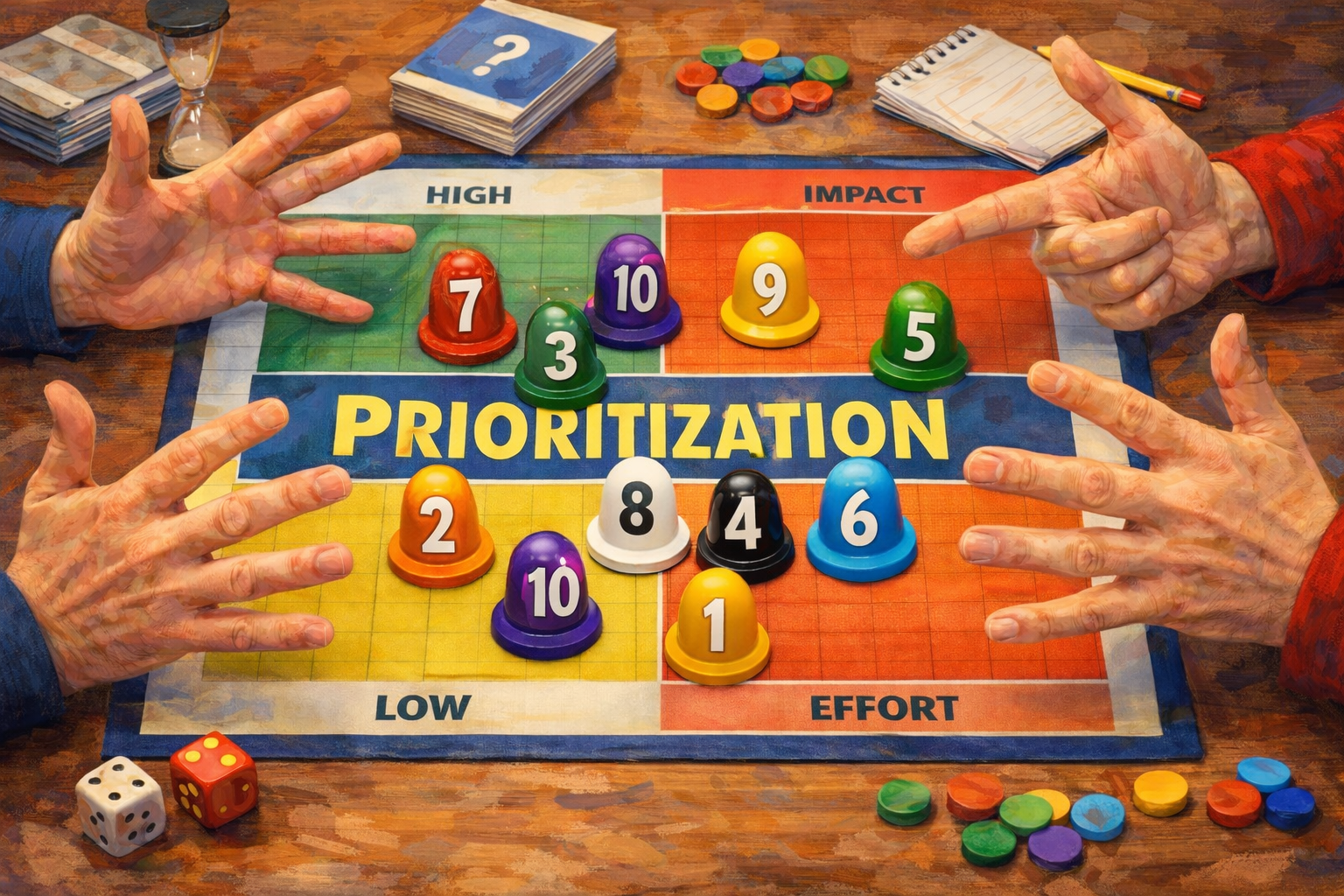
Inflection Point
Ever struggle to gain agreement over prioritization of product initiatives? Better question: is it ever not a struggle?
Too often, resolution is based upon the loudest voice in the room, the biggest customer’s demands, recent technology developments, or competitor moves. That’s submission, not prioritization.
Particularly at key inflection points—when markets shift, new technologies emerge, or economic conditions change—the companies that respond effectively are not necessarily those with the most ideas, the largest teams, or the most resources. They are the ones that prioritize correctly.
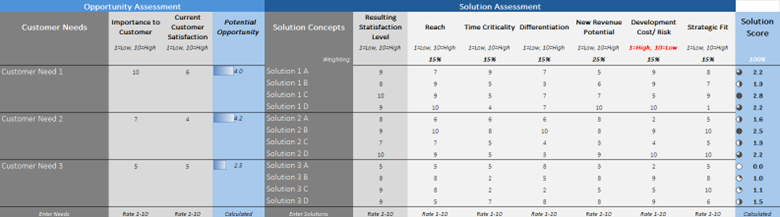
Offered here is a clear, customizable framework to align both the Opportunities you are addressing and the Solutions you proposeto meet them.
Download the Prioritization Framework
How Big a Problem is Prioritization?
Prioritization failures are more common than many teams realize.
Only 6% of Executives Are Satisfied With Innovation Performance
Source: McKinsey & Company – Global Innovation Survey
Only 14% of Companies Truly Understand Their Customers
Source: Harvard Business Review – research on customer-centric organizations
Up to 80% of Product Features Are Rarely or Never Used
Source: Pendo – Feature Adoption Report
72% of Executives Say Their Innovation Efforts Are Misaligned With Strategy
Source: PwC Strategy – Global Innovation Research
These statistics point to a deeper issue: organizations often struggle to identify which problems truly matter and which solutions deserve investment. Companies that lack a disciplined prioritization framework tend to react to noise rather than signal. Those that prioritize effectively can concentrate their resources on the initiatives most likely to create value in changing conditions.
About the Framework
This tool expands upon the opportunity assessment approach of both Dan Olsen’s Lean Product Playbook and of Tony Ulwick’s Outcome Driven Innovation method while adding a customizable set of solution prioritization criteria. The matrix rates each item based upon both:
Its potential to satisfy customer needs and
How well it suits your business goals and constraints.
Instructions for how to apply this framework to your business are included in the Excel download.
Synchronizing Prioritization of Opportunities and Solutions
Effective prioritization requires addressing two distinct questions:
Which opportunities matter most?
Which solutions best pursue those opportunities?
Many teams focus on only one of these.
Opportunity Prioritization
Focus first on identifying the customer needs that are most important to them but which are least satisfied today.
If an identified customer need is low, there’s no need to spend time solving it.
If a customer need is high but is already well met, there is little opportunity to make an impact. (Though solutions for such needs might be considered table-stakes.)
We’re looking for high importance needs that are poorly satisfied. These offer the greatest opportunity to create value and thus, the best place to invest resources.
Solution Prioritization
There are many rubrics for classifying and prioritizing solutions such as: RICE, WSJF, MoSCoW, KANO, and others. While useful, all rely on standard prioritization criteria that oftendo not capture the particulars of your company’s strategy, resources, constraints, markets, customers, or other factors that are necessary to relevant prioritization.
The custom criteria approach solves this problem.
Instead of relying solely on generic scoring factors, you define the criteria that reflect what success means for your organization.
Selecting those criteria is itself a valuable exercise. It requires discussing options with key stakeholders across:
Product
Marketing
Engineering
Sales
Finance
Business leadership
The goal is to identify the five or six factors that truly determine which initiatives deserve investment.
This process can be clarifying—and sometimes contentious. But with it, half the battle is won. The organization now has a shared language for discussing priorities, which dramatically improves decision-making when evaluating initiatives.
Within the framework download you’ll also find about 20 potential criteria to consider.
Try It
A disciplined prioritization framework is a powerful tool for the everyday alignment of product initiatives. But it is an invaluable tool when key inflection points hit. In the midst of change that disciplined approach helps calmly align opportunities and solutions around what is most important.
Start prioritizing based on both Opportunities and potential Solutions using a framework that adapts to your business.